
Pregnancy and Postpartum Therapist for Women in Marin County, CA
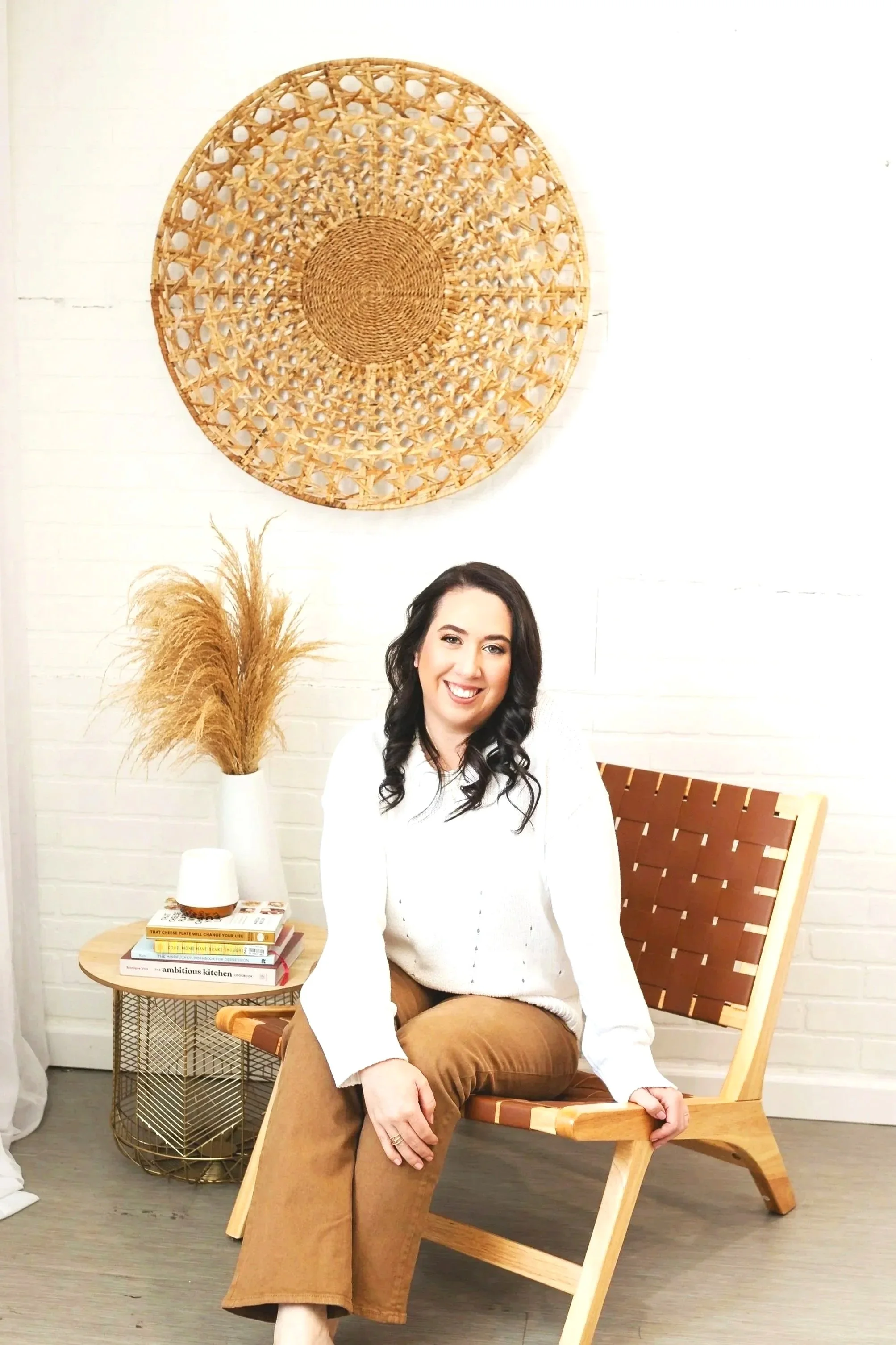

From the hills of Mill Valley to San Francisco, the pressure to "curate" a seemingly perfect motherhood experience is relentless.
You aren’t failing; you are paying a Perfectionism Tax. It’s time to stop white-knuckling the mental load and implement a tactical framework for your identity.
My Process

Step 1
Book your free 10-minute vibe check
Step 2
Complete your intake session together
Step 3
Start feeling like yourself again
High-Performance Motherhood. Hidden Internal Burnout.
-
Marin County has a particular kind of pressure woven into its culture. It's progressive, outdoorsy, and community-oriented on the surface — and quietly, relentlessly demanding underneath. If you are a mother here, you already know this. The hiking trails, the farmers markets, the preschool co-ops — all of it comes with an unspoken expectation that you are not just mothering, you are curating a life. And doing it beautifully.
I'm Alexa — a licensed therapist, a mother of two, and founder of Therapy For California Moms. I am a specialist in supporting moms in navigating the mental and emotional weight of California motherhood. I work virtually with women across Marin County, the North Bay, and the greater Bay Area who are navigating postpartum depression, postpartum anxiety, the Invisible Load, and the particular exhaustion that comes from holding everything together while quietly falling apart inside.
This page is for you if you love your life on paper and can't figure out why you feel so empty in the middle of it.
This is the high-functioning presentation of postpartum depression and postpartum anxiety. It is the version where you are still delivering at work, still managing the household, still present at the pediatrician appointments and the school waitlist tours — but you are doing all of it from a place of profound internal depletion, feeling more like a function than a person, more like a role than a woman.
In a community that runs on achievement and optimization, this version of struggle is especially hard to name. The bar for what a high-performing mother is supposed to look like here is extraordinarily high. Admitting that you are not okay — not just tired, but genuinely struggling — can feel like a professional and social liability in a way that is particular to the Peninsula culture.
The Invisible Load is the engine underneath most of it. It is not the visible tasks — the feeding schedules, the childcare logistics, the school research. It is the cognitive and emotional labor that happens before any of those tasks, the constant background processing of what everyone in your household needs before they know they need it. It is being the Default Parent — the person whose mental bandwidth is permanently occupied by the architecture of everyone else's lives, leaving almost nothing for your own. In dual-career Peninsula households where both partners are operating at high professional intensity, this load almost always falls disproportionately on the mother. And it accumulates, invisibly, until it becomes the thing you cannot manage your way out of.
This is the Perfectionism Tax — the invisible emotional cost of maintaining an optimized exterior while your internal identity is steadily being erased. You are not failing at motherhood. Your nervous system is overwhelmed and under-resourced. That is a clinical reality, not a personal failing.
High-Functioning on the Outside. Running on Empty Inside.
There is a version of maternal burnout that doesn't look like burnout at all. It looks like a well-managed household, a successful career, a beautiful child, and a full social calendar. It looks like you.
In Marin County, the cultural landscape makes this especially complicated. The progressive parenting standards here are high — intentional play, thoughtful nutrition, screen-time consciousness, emotionally attuned discipline. Add a demanding career, a partner with their own career, and the invisible infrastructure of running a family that lives entirely inside your head, and you have the conditions for the kind of depletion that doesn't show up on the outside.
This is the Invisible Load. It is not just the tasks — it is the tracking, the anticipating, the orchestrating, the remembering. It is being the Default Parent, the one whose mental bandwidth is perpetually consumed by the logistics of everyone else's lives, leaving almost nothing left over for your own. And in a community where women are expected to be both professionally formidable and mindfully present as mothers, the cost of carrying that load quietly is enormous.
You are not failing. You are paying a Perfectionism Tax that no one told you would be this expensive.
I'm Alexa — a licensed therapist, a mother of two, and founder of Therapy For California Moms. I am a specialist in supporting moms in navigating the mental and emotional weight of California motherhood. I work virtually with women across Marin County, the North Bay, and the greater Bay Area who are navigating postpartum depression, postpartum anxiety, the Invisible Load, and the particular exhaustion that comes from holding everything together while quietly falling apart inside.
This page is for you if you love your life on paper and can't figure out why you feel so empty in the middle of it.
This is the high-functioning presentation of postpartum depression and postpartum anxiety. It is the version where you are still delivering at work, still managing the household, still present at the pediatrician appointments and the school waitlist tours — but you are doing all of it from a place of profound internal depletion, feeling more like a function than a person, more like a role than a woman.
In a community that runs on achievement and optimization, this version of struggle is especially hard to name. The bar for what a high-performing mother is supposed to look like here is extraordinarily high. Admitting that you are not okay — not just tired, but genuinely struggling — can feel like a professional and social liability in a way that is particular to the Peninsula culture.
The Invisible Load is the engine underneath most of it. It is not the visible tasks — the feeding schedules, the childcare logistics, the school research. It is the cognitive and emotional labor that happens before any of those tasks, the constant background processing of what everyone in your household needs before they know they need it. It is being the Default Parent — the person whose mental bandwidth is permanently occupied by the architecture of everyone else's lives, leaving almost nothing for your own. In dual-career Peninsula households where both partners are operating at high professional intensity, this load almost always falls disproportionately on the mother. And it accumulates, invisibly, until it becomes the thing you cannot manage your way out of.
This is the Perfectionism Tax — the invisible emotional cost of maintaining an optimized exterior while your internal identity is steadily being erased. You are not failing at motherhood. Your nervous system is overwhelmed and under-resourced. That is a clinical reality, not a personal failing.
What Postpartum Depression Looks Like in Marin
-
Postpartum depression does not always look like what you'd expect. In Marin County, it often doesn't look like being unable to function — it looks like functioning perfectly while feeling nothing. Or feeling everything, all at once, in waves you can't explain to anyone around you.
Postpartum depression in high-achieving women frequently presents as numbness, disconnection, or a persistent sense that something is wrong without being able to name what it is. You go through the motions. You are present at the playgroup, the pediatrician appointment, the work call — but you're watching yourself do it from somewhere far away. You wonder if you bonded with your baby correctly. You feel guilty for not feeling the joy you thought you'd feel. And you don't say any of this out loud, because in Ross or Kentfield or Greenbrae, you are not supposed to be struggling like this.
Postpartum depression is a medical condition. It is not a reflection of how much you love your child, how capable you are, or who you are as a woman. It is treatable. And the longer it goes unaddressed, the heavier it gets.
If any part of this resonates, you are not broken. You are simply overdue for support that actually meets you where you are.

What Postpartum Anxiety Looks Like in Marin
-
Postpartum anxiety is often the most under diagnosed perinatal mood disorder, and it is extraordinarily common in high-achieving, high-conscientiousness women — which describes most of the mothers I work with in the North Bay.
Postpartum anxiety looks like this: your brain is running a constant background threat assessment. You cycle through worst-case scenarios at 2am. You feel like you have to be in control of every variable because if you stop managing everything, something will fall apart. You are hypervigilant about your baby's safety in a way that feels less like love and more like dread. You snap at your partner and immediately hate yourself for it. You feel judged by your own parents or in-laws for not having it together — even when, from the outside, you clearly do.
In a community where the bar for parenting is exceptionally high, postpartum anxiety can masquerade as high standards for a long time before anyone — including you — names it as anxiety. The hypervigilance feels familiar. It's the same drive that made you effective professionally. But there is a meaningful difference between high standards and a nervous system that cannot come down from red alert.
Postpartum anxiety is not a personality trait. It is a clinical pattern with effective, evidence-based treatment. You do not have to manage this alone, and you do not have to keep performing calm when you are anything but.

About Me
Hi I’m Alexa, I am a licensed therapist, a mom of two, and a specialist in the high-stakes transition of modern motherhood.
With over 5,000 hours of clinical experience, I’ve moved beyond "supportive talk" to offer a results-oriented framework for women in high-resource environments.
I understand the unique intersection of professional ambition and maternal identity because I live it.
My mission is to ensure that while you care for your family, you don’t lose the person you worked so hard to become.

Hello!I'm Alexa — a licensed therapist based in California, a mother of two, and someone who has navigated my own experience with postpartum depression and postpartum anxiety. I know what it feels like to be the person everyone else looks to for stability while quietly running on fumes.
My clinical approach is direct and results-oriented. In our sessions we build a concrete framework for understanding what is happening internally, what is driving the Invisible Load, and how to start reclaiming the identity that has been slowly consumed by the Default Parent role. My work is grounded in the research on maternal mental health and shaped by over 5,000 hours of clinical experience with women in high-pressure environments across California.
I understand the specific cultural texture of Marin County — the progressive parenting culture, the high professional expectations, the pressure to make it all look effortless. You don't need to explain your life to me. You need someone who already gets the context.
What Our Work Together Looks Like
My approach is clinical, direct, and built around results. We build a precise, concrete framework for understanding what is happening and digging deep to uncover root causes (not just symptoms.)
We begin with a thorough intake that gives me the full picture of your life — not just your symptoms, but your nervous system, your relationship, the specific Invisible Load you are carrying, and the cultural context of your life on the Peninsula. From there, I build a treatment plan tailored specifically to your presentation of postpartum depression or postpartum anxiety and designed to work within the pace and demands of your actual schedule.
Our work focuses on three areas.
01
Neural Regulation
Moving your nervous system out of chronic survival mode and back toward responsive calm, where you can be genuinely present in your own life.
02
Identity Reclamation
Recovering the sense of self that has been consumed by the Default Parent role and rebuilding your relationship with who you are beyond what you produce and who you care for.
03
Relational Clarity
Addressing the dynamics that the Mental Load creates in your partnership, including the resentment that builds when one person carries the invisible infrastructure of a family without acknowledgment or relief.

Why Virtual Therapy Is the Right Fit for Marin Moms
Your recovery should not depend on the traffic on the 101 or whether you can get across the Richmond Bridge in time for a 50-minute session. My practice is 100% virtual, which means we meet wherever you are — your home office, your car during nap time, your living room after the kids are asleep.
Virtual therapy is not a compromise. For the women I work with in Mill Valley, Tiburon, San Rafael, and Novato, it is the only model that actually fits a life this full. You get access to a specialist in maternal mental health without adding another commute to your week.
I maintain a small, intentionally limited caseload. This is not a high-volume practice. Every client I work with gets a level of clinical focus and continuity that a larger practice simply cannot offer.
The Investment
Sessions are $275. I am an out-of-network provider. Many clients in Marin County use their PPO out-of-network benefits and receive meaningful reimbursement directly from their insurance. I provide the documentation you need to submit your claim.
This is a private-pay practice because insurance-driven care is not built for the depth or specificity of work we do here. The focus is entirely on your results, your nervous system, and your recovery — not on what a billing code will authorize.
Your Questions, Answered
FAQ: Postpartum Therapy in Marin County
-
Yes. I work virtually with women across all of Marin County, including Mill Valley, Tiburon, Ross, Kentfield, San Rafael, Novato, Greenbrae, Sausalito, and Corte Madera.
-
Postpartum depression and postpartum anxiety are distinct clinical conditions, though they frequently co-occur. Postpartum depression often presents as numbness, disconnection, persistent sadness, or a loss of identity. Postpartum anxiety typically presents as hypervigilance, intrusive thoughts, chronic worry, and a nervous system that cannot come down from high alert. Both are treatable and both deserve specialized clinical attention — not a general therapist who sees a little bit of everything.
-
The Invisible Load is the mental architecture of running a family that lives entirely in your head — the tracking, anticipating, scheduling, and orchestrating that never makes it onto a shared to-do list because it happens before anyone else even knows something needs to happen. In therapy, we work to identify how the Invisible Load is affecting your nervous system, your relationship, and your sense of self — and build concrete strategies for redistributing it and protecting your own mental space.
-
Normal postpartum exhaustion lifts — it responds to sleep, support, and time. Postpartum depression doesn't. If you have been feeling numb, disconnected, persistently sad, rageful, or like a stranger in your own life for more than two weeks, that is worth taking seriously. A clinical consultation is the fastest way to get clarity on what you're actually dealing with.
-
Many of the women I work with carry an additional layer of guilt or shame around seeking support — particularly when family members hold the view that postpartum struggles are something to push through privately. Part of what we address in therapy is untangling your wellbeing from the expectations of people who don't understand what you're actually experiencing. You do not owe anyone a performance of fine.
-
Book your first session directly through my website. We'll start with a focused intake to understand the full picture of what you're navigating, and build a treatment approach from there. Book your free 10 minute consult today! I can’t wait to support you during this season of motherhood!